The Impact of AI on Job Markets and New Careers Emerging in 2025

The Impact of AI on Job Markets and New Careers Emerging in 2025
For workers and employers alike, the potential and difficulties that are presented by the ongoing evolution of the global workforce due to artificial intelligence remain significant. Artificial intelligence (AI) is not only causing some old tasks to be automated, but it is also contributing to the development of totally new occupations and skill sets. It is essential for individuals, firms, and politicians that want to manage the changing labor market environment in 2025 to have an understanding of these developments.
Automation and Its Impact on the Evolution of Conventional Employment
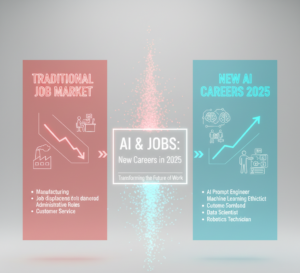
Artificial intelligence has made it possible to automate a large number of regular, repetitive, and data-driven jobs across a wide variety of businesses. Artificial intelligence (AI) systems are being used more and more often to do activities such as data input, basic analysis, and regular communication in a variety of industries, including manufacturing, transportation, customer support, and finance. Even though this may result in a decrease in demand for some positions, it also allows those who are employed as workers to concentrate on more advanced activities that need the use of creativity, problem-solving skills, and emotional intelligence.
Novel Positions Being Created Due to the Incorporation of Artificial Intelligence
The advent of artificial intelligence has resulted in the emergence of totally new career paths that are centered on the development, administration, and optimization of intelligent systems. There is a significant and expanding need for positions in the fields of artificial intelligence ethics, machine learning operations (MLOps), data annotation, and artificial intelligence product management. These positions demand that the individuals who fill them have a mix of technical proficiency, strategic thinking skills, and domain-specific knowledge, hence presenting opportunities with high demand for those who are ready to make the necessary adjustments and improve their skill sets.
Roles That Are Enhanced by Artificial Intelligence
Rather than being extinct, a large number of extant professions are undergoing a process of evolution. For example, artificial intelligence is currently used by healthcare practitioners to aid in the process of making predictions about future outcomes, diagnostic assistance, and the development of individualized treatment plans, which enables physicians and nurses to reach conclusions that are both more timely and more informed. In the same way, marketers use artificial intelligence (AI) technologies to improve the efficiency of their campaigns, examine the behavior of customers, and create content, so improving productivity while yet retaining strategic supervision.
Skills That Will Be in High Demand in 2025
There is a growing need for individuals who have a strong technical background in areas such as artificial intelligence, machine learning, natural language processing, and data analysis. Having said that, soft skills continue to be just as important. The ability to think critically, creativity, emotional intelligence, and ethical reasoning are all important qualities when it comes to operating artificial intelligence systems in a responsible manner and making judgments that need the use of human judgment. Those who are able to combine these skills will be well positioned in the workforce as it continues to evolve.
Prospects for the Future in Artificial Intelligence-Driven Industries
The expansion of industries such as autonomous transportation, robotics, finance, healthcare, cybersecurity, and renewable energy is being significantly pushed by artificial intelligence. Positions in the fields of artificial intelligence research, sensor engineering, intelligent automation, and human-artificial intelligence cooperation are becoming more common career pathways that are on the rise. In addition, the ability to work remotely and the usage of digital platforms provide access to worldwide prospects related to artificial intelligence, which further increases the number of prospective career options.
Issues Concerning Ethics and Policy
In the face of the problems brought on by the reshaping of labor markets by artificial intelligence, companies and governments must deal with issues like as the displacement of the workforce, training, and fair access to opportunities. In order to make sure that the advancements in technology are advantageous for employees and the whole community, it is of the utmost importance to develop policies that support responsible artificial intelligence (AI) application, reskilling, and lifelong learning. Firms that commit to the professional development of their staff and to the responsible integration of artificial intelligence are more likely to be successful in a competitive environment.
Achieving a Balance between Automation and Human Creativity
Although artificial intelligence is very proficient in the areas of pattern recognition and efficiency, human capabilities such as empathy, creativity, and the ability to make judgments continue to be irreplaceable. By the year 2025, the most successful organizations will use artificial intelligence as a collaborative tool that enhances human talents rather than completely replacing them. Organizations are able to increase efficiency while simultaneously upholding innovation and providing customized experiences because of this balance.
Getting Ready for the Workforce of Tomorrow
Embracing lifelong learning, keeping up with the latest technological advancements, and building abilities that span several disciplines are all ways in which professionals may be ready for the changes that artificial intelligence will bring. It will become more important to have experience with artificial intelligence tools, to grasp what they are capable of, and to learn how to interact successfully with intelligent systems in order to achieve professional advancement.
A Look into the Future
Artificial intelligence will continue to bring about changes in the work market, resulting in both the displacement of jobs and the creation of new possibilities. The people who will be successful in 2025 and beyond are those who are able to adapt, reskill, and concentrate on abilities that are distinctively human. Through the responsible and planned use of artificial intelligence (AI), companies and workers are able to use its capabilities in order to provide meaningful job opportunities, productivity, and creativity.
The roles of people are being redefined, and new professional landscapes are being created by artificial intelligence, which is doing far more than just replacing occupations. Those professionals who have a grasp of the continuously changing artificial intelligence (AI) environment, who are able to integrate their technical knowledge with their human abilities, and who are committed to the concept of ongoing learning will find themselves at the vanguard of this period of transformation.